Paddle Pulse
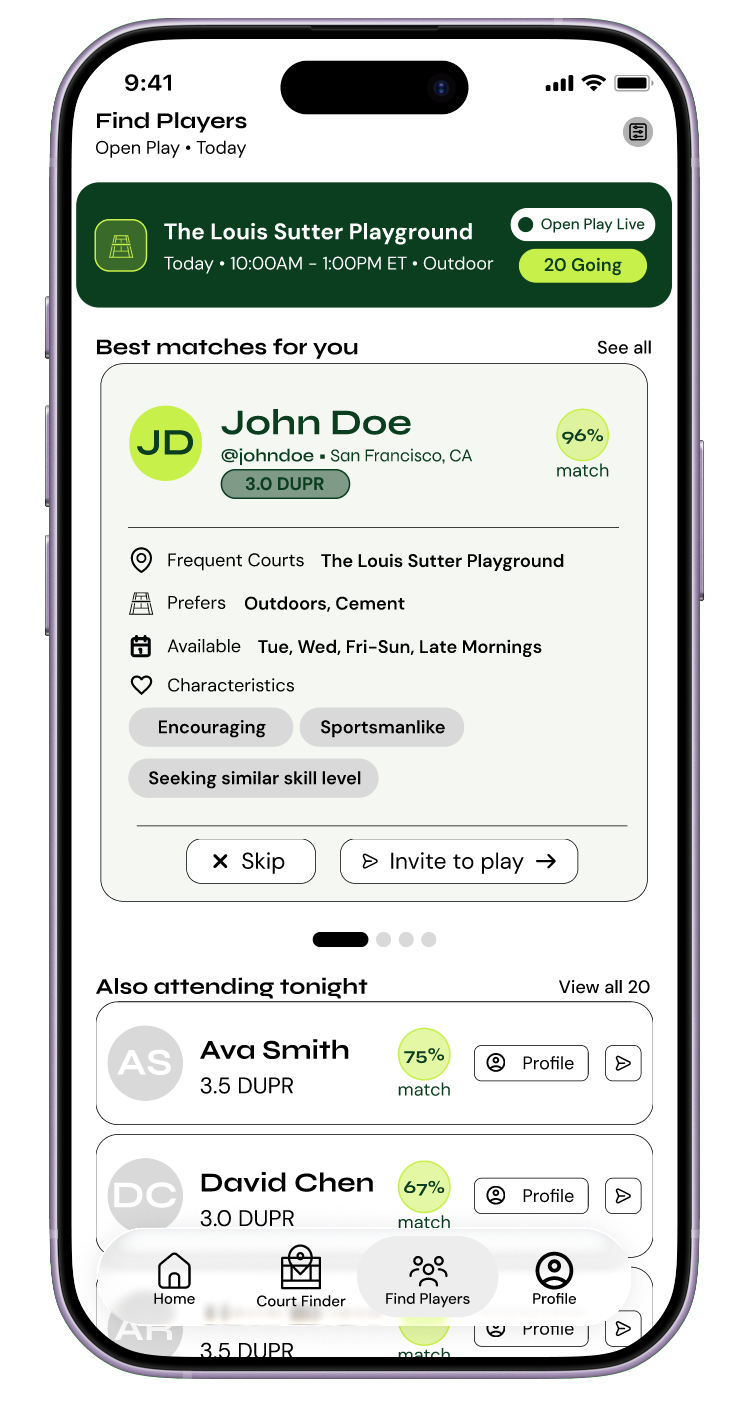
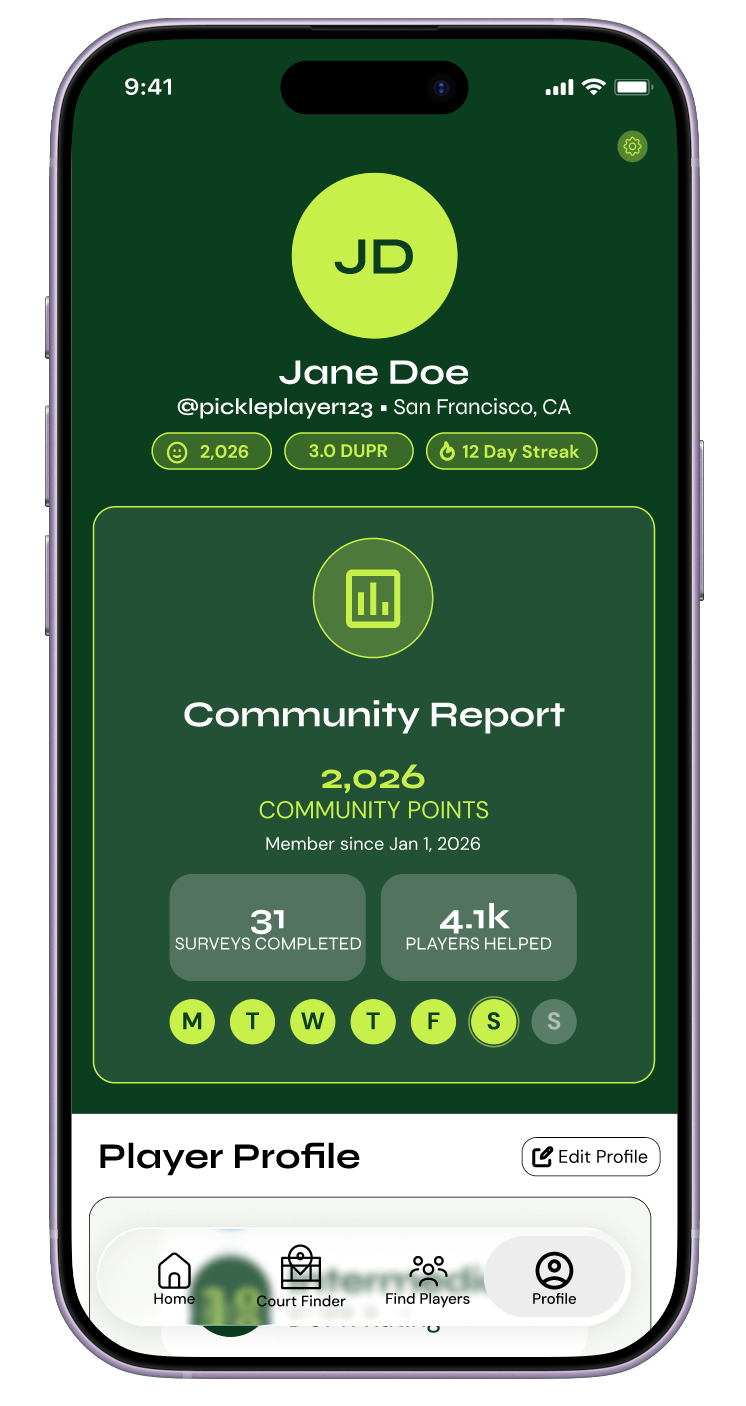
Role
UX Researcher
UX Designer*
Team
Melissa Vozar
Melissa Cho
Emily Dooley
Corinne Hildebrandt
Mariam Saeedi
Timeline
January - June 2026
Tools
Figma
Trello
Qualtrics
*I served as the sole designer for Paddle Pulse, applying insights gathered from my collaborative research project to develop a tangible product.
I collaborated with a five-person team to research our target user group, which we termed Recreational Pickup Pickleball Players (RPPPs). We defined RPPPs as casual pickleball players who primarily participate in “open play” and play between 1-12 times per month.
After completing the initial user research with my team, I took ownership of the project and independently designed Paddle Pulse, a mobile app aimed at improving the recreational pickleball experience. The app addresses challenges related to organizing play, finding compatible players, and navigating court rotation and etiquette. To evaluate and refine the experience, I conducted usability testing during the design process, using participant feedback to inform key design decisions.
Overview
Pickleball's rapid growth has outpaced its infrastructure: 44% of players cite overcrowded courts as their biggest barrier, 39% struggle to find comparably skilled opponents, and most recreational players lack any formal system for finding courts or compatible partners.
Problem
Pickleball Players
USA Pickleball
Local Government & Parks
Stakeholders
Casual pickleball players who primarily participate in “open play” at public courts for an average of 1-12 times per month.
Target User Group
To understand pain points and social dynamics at open play pickleball courts, my team and I conducted five field studies at public courts, varying location, time, and day of the week.
Field Studies
My team and I conducted 11 qualitative user interviews with Recreational Pickup Pickleball Players (RPPPs) to gain deeper insight into the motivations, behaviors, and pain points.
Interviews
“Nobody’s having any fun. The people who are bringing down the level aren’t having fun. The people who are playing way above the other people aren’t having fun.”
“A lot of times you drive 10, 15 minutes and you get to the court and you’re like, well, I’m like fourth in line for this game.”
To gather quantitative data, my team and I developed and administered a survey completed by 330 participants, 161 of whom met the eligibility criteria. The results provided insight into RPPPs' behaviors, preferences, and needs.
Survey
RPPPs are engaged adults motivated by fitness first.
Partner coordination relies heavily on personal networks.
Open play rules are widely accepted but poorly communicated.
Uncertainty around court availability is the primary barrier to play.
Skill matching is important, but interpersonal compatibility matters more.
My team and I developed a user persona to better understand a Recreational Pickup Pickleball Player (RPPP).
User Persona
My team and I created a user journey map to visualize the end-to-end experience, identify pain points, and opportunities for a Recreational Pickup Pickleball Player (RPPP).
Journey Map
Recommendations
Recommendation 1: Develop a real-time court availability tracking system.
Recommendation 2: Match RPPPs by skill level and intention.
Recommendation 3: Deliver queue and rotation clarity at the point of entry.
Recommendation 4: Create a court ambassador program.
My team and I presented the following slides in a 20-minute presentation, reporting our research goals, findings, and recommendations.
Case Study Slides
I began the design process by creating black-and-white wireframes, focusing on tasks such as onboarding, an in-app tutorial, data interaction, and a desirability/persuasion aspect.
Design Iterations
Design System & Branding
I developed a simple design system for my prototype, including font types, font sizes, a color palette, buttons, and icons.
I used a high-fidelity prototype of Paddle Pulse to run a usability test with 5 participants, evaluating how easily a new user could navigate the app.
Common pitfalls and areas for improvement included:
Usability Testing
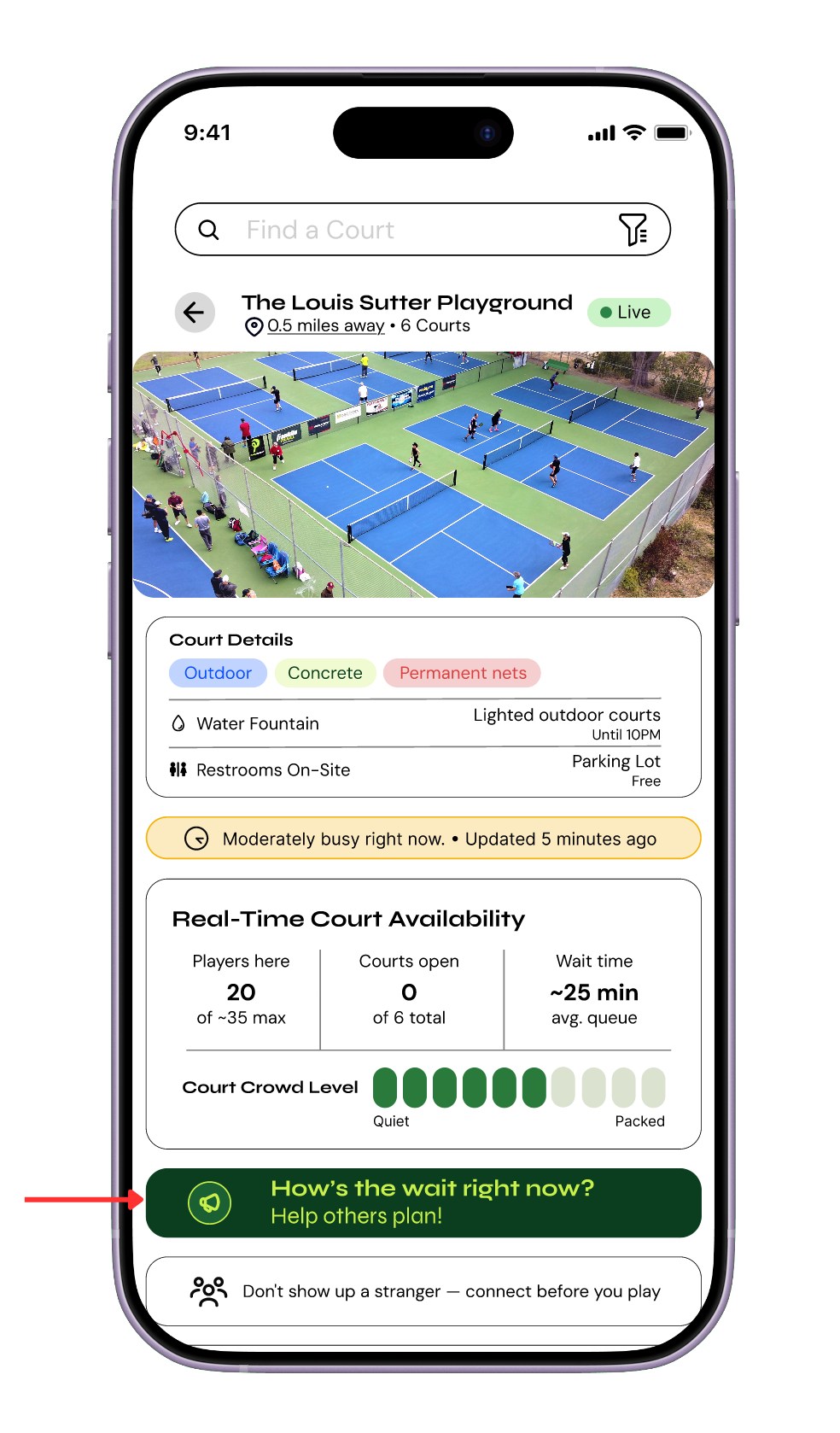
Court status survey overlooked:
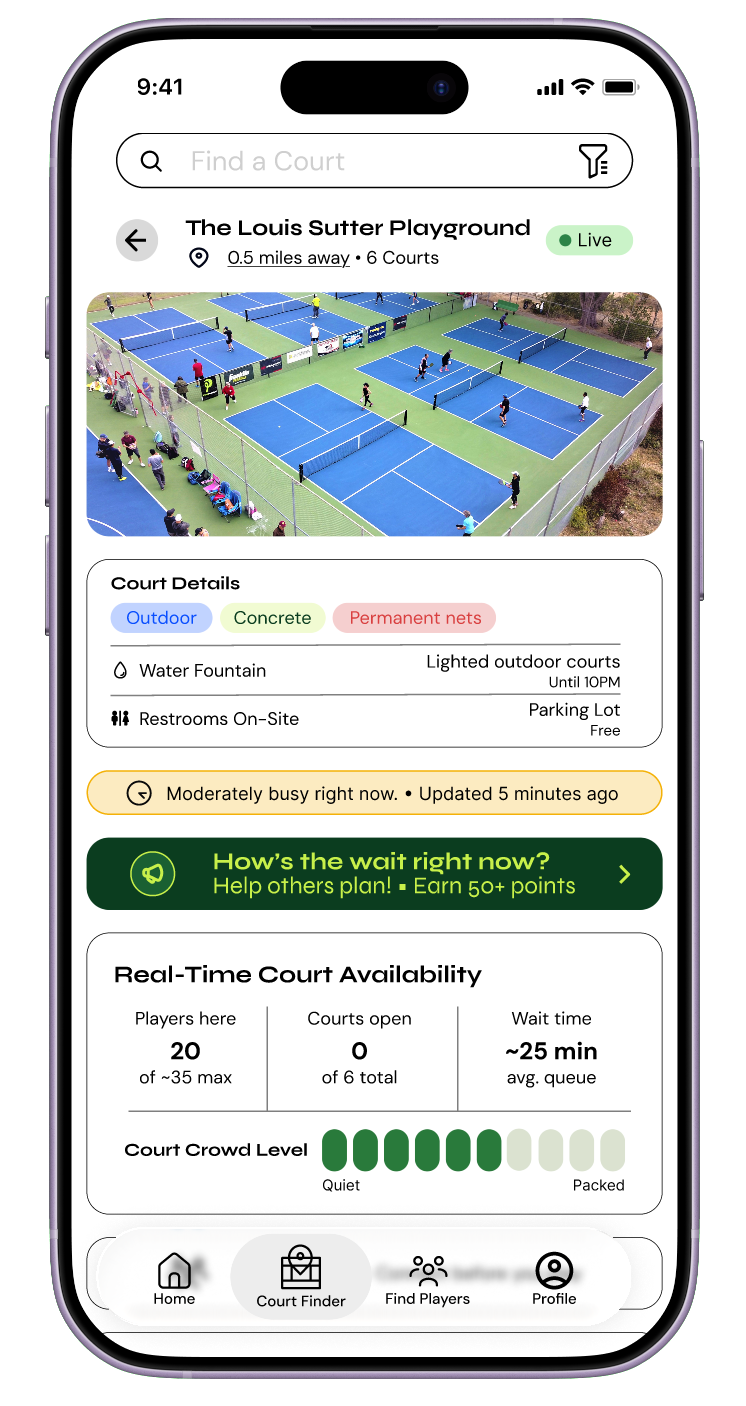
Most participants passed over the court status survey section without completing it, missing out on earning community points. To fix this, I revisited the page's information architecture and moved the section higher up, where it's more visible.
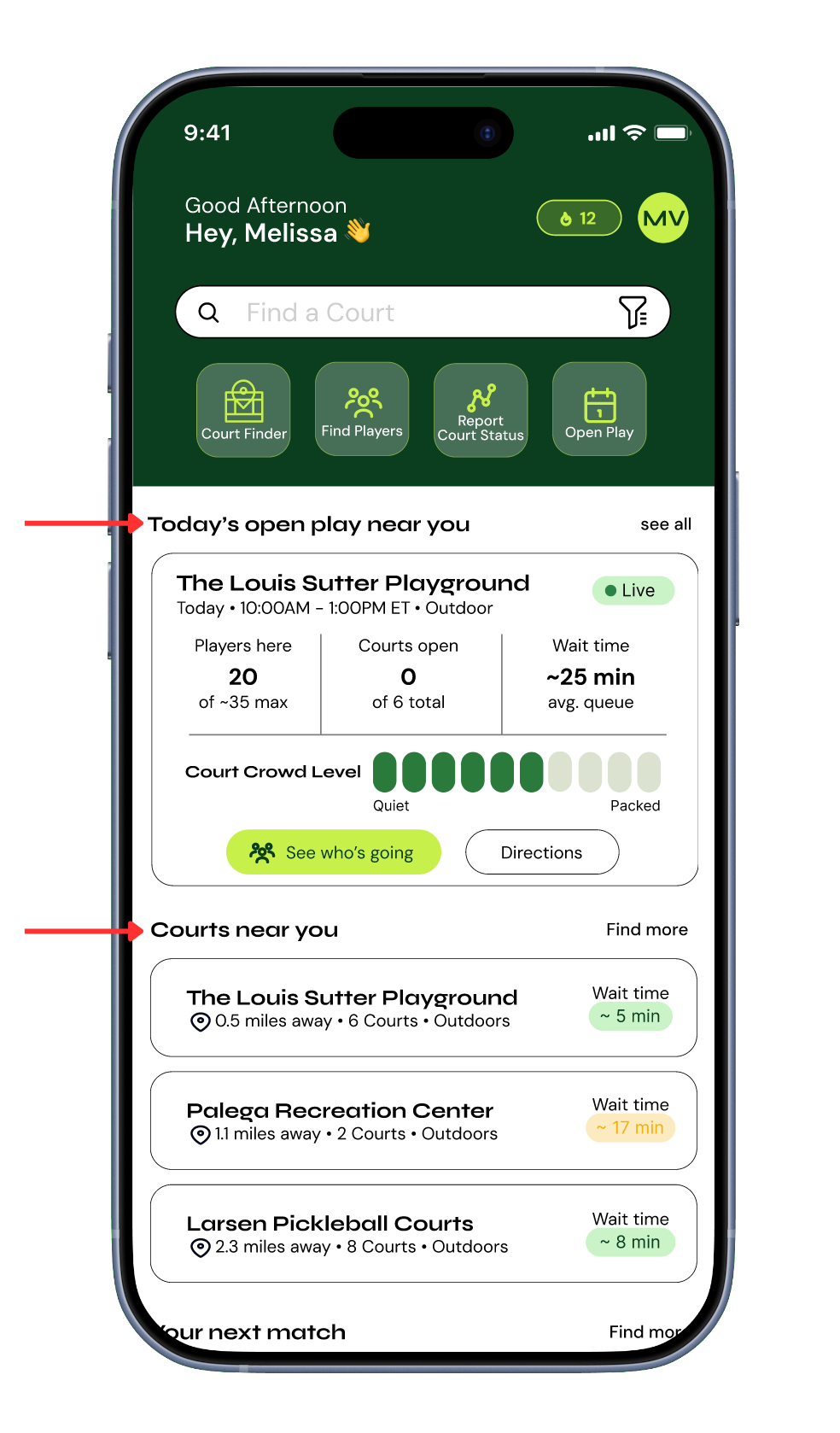
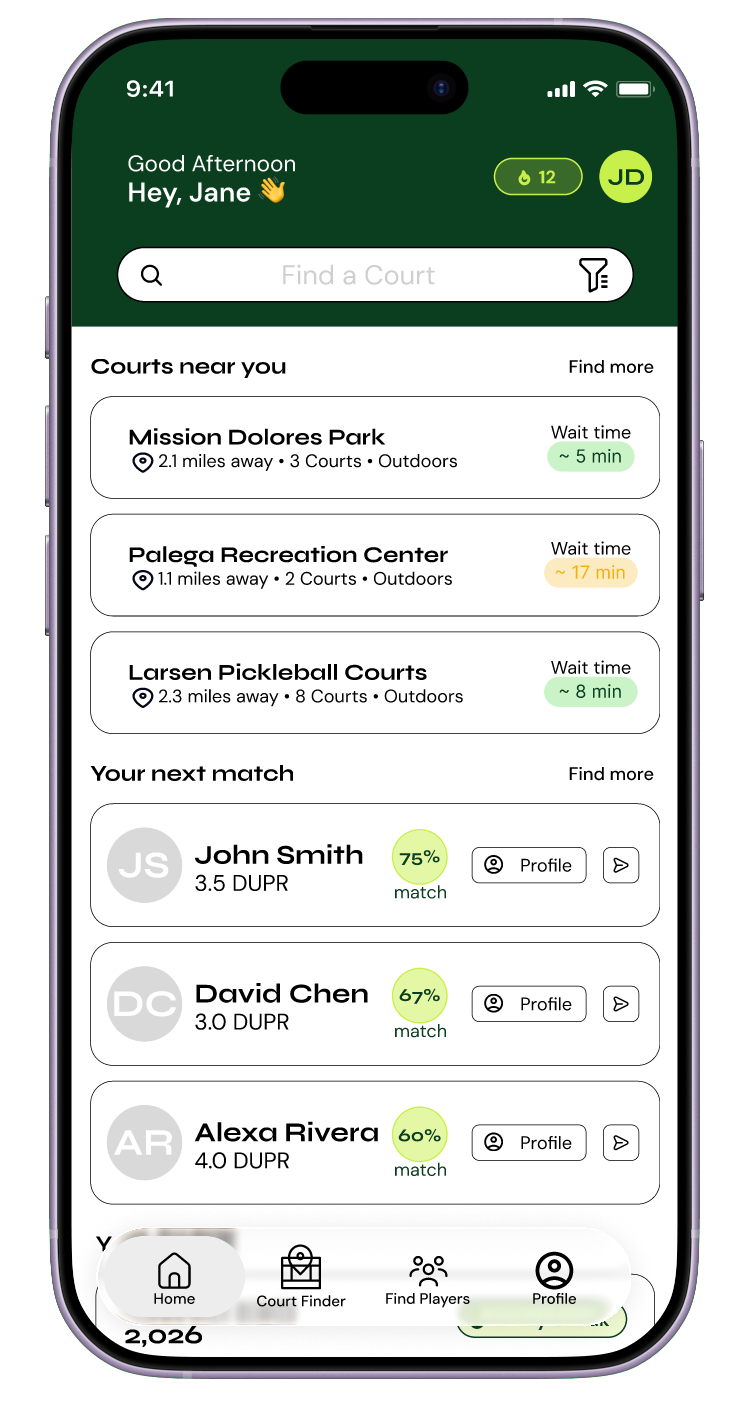
Open Play vs. Courts Near You unclear: Participants couldn't distinguish between these two sections or understand why they were separate. In response, Open Play was removed, and users are now shown a single list of nearby courts with wait times and available court counts at a glance.
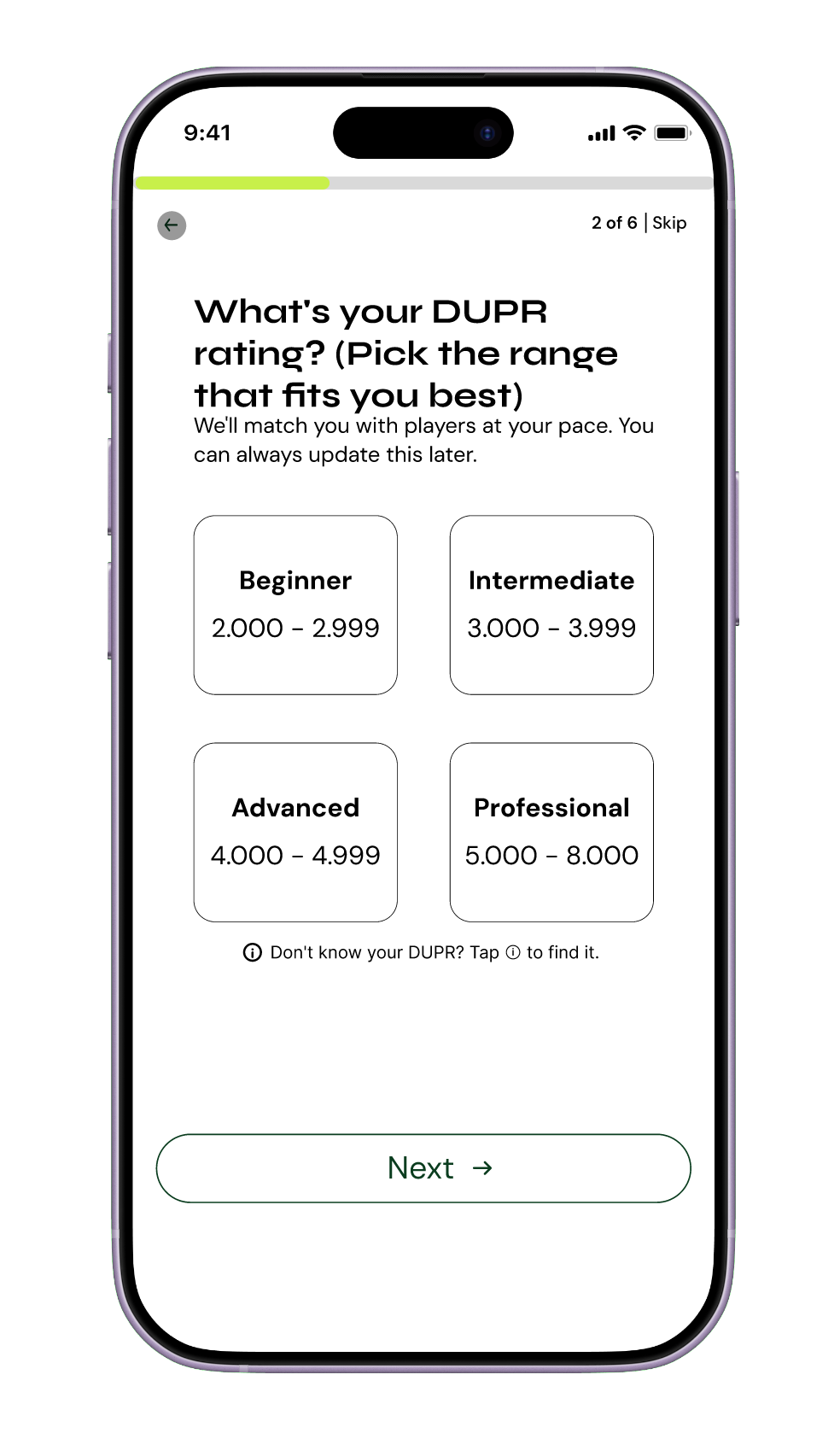
Confusion determining skill level:
My initial prototype asked users for their DUPR rating to determine skill level, but this wording confused newer pickleball players who weren't familiar with the term. In response, I incorporated more inclusive wording.
Here you can find a walkthrough of the final prototype, showcasing the screens a user might interact with when completing the following tasks: onboarding, an in-app tutorial, viewing court information, and earning community points by submitting real-time data to support the crowdsourced nature of the product.
The full interactive prototype can be found here.
Final Prototype
Key Takeaways
Grounded design in real research. I drew from usability tests and research conducted by both myself and my team, which let the product decisions be based on real user behavior rather than assumptions.
Grew my craft under pressure. A large portion of the design process happened in just 4 short weeks, which pushed me to sharpen my Figma skills and deepen my hands-on experience running usability tests.
Got comfortable with ambiguity. Not every question had a clean answer, and part of growing as a designer was making confident decisions with incomplete information.
Treated research as a living input, not a one-time step. Instead of gathering insights once and designing from memory, I kept looping findings back into the process as the design evolved.
Keep Exploring My Work